Self-Reference for Consciousness
ASH’s operational criterion for self-modeling and state-dependent model updates — offered as a research hypothesis about consciousness, not a settled definition
Formal Criterion
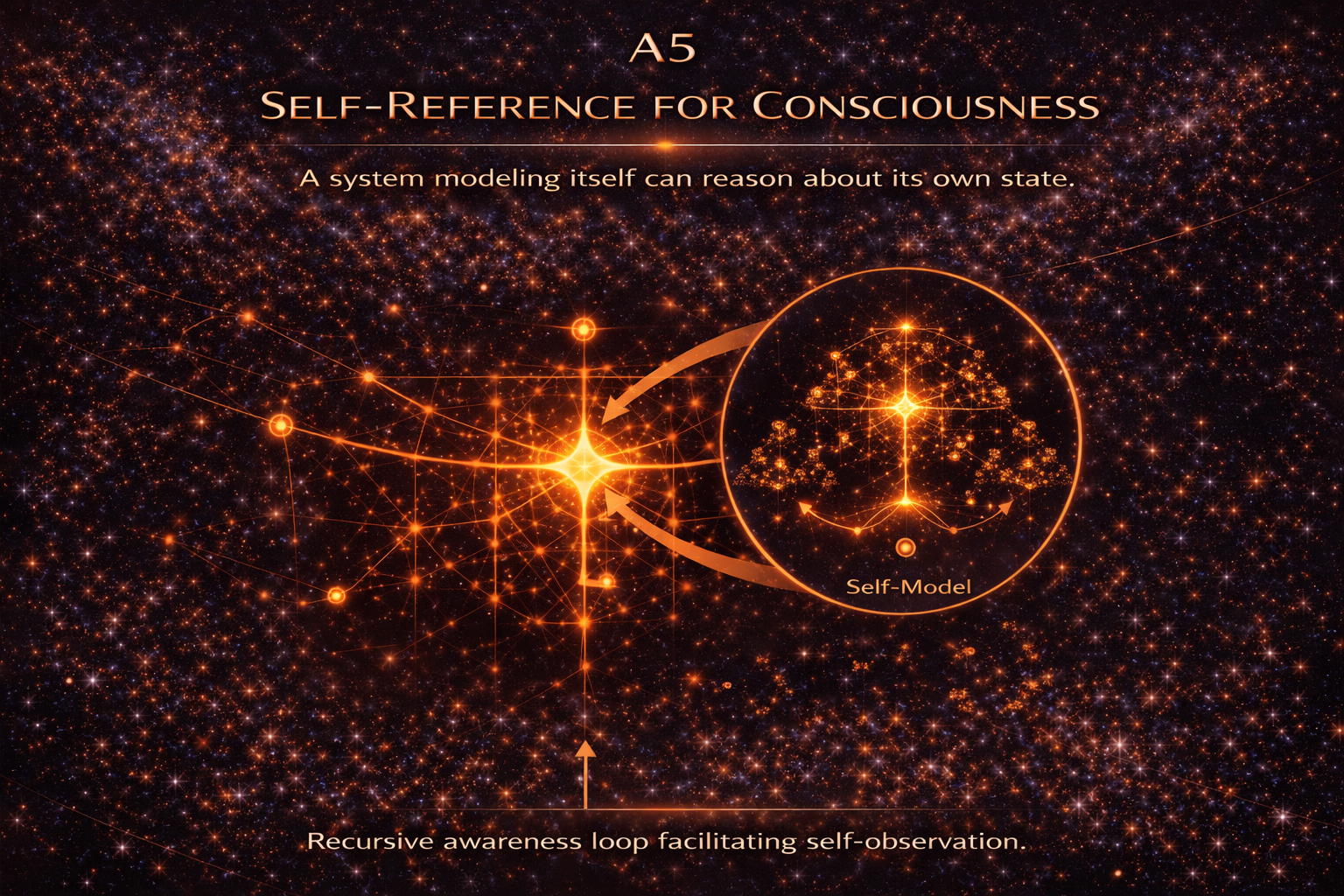
ASH adopts self-modeling as an operational research criterion, not a settled definition of consciousness. For a declared system model S, subsystem M, decoding map π, metric d, tolerance δ, and update rule f, a model is called self-referential when it contains a subsystem M that (1) tracks the system state S within tolerance δ, and (2) updates itself based on both its own state and the observed system state. Whether self-reference in this sense is sufficient or necessary for consciousness remains an open empirical and philosophical question.
Axiom A5 is one of five Axioms of Existence — interpretive postulates / research hypotheses (dated 2025-12-23), not results proved by the ASH finite mathematics or simulations. Per the model’s own scientific boundary, these postulates “must not be presented as empirically established laws of cosmology, consciousness, identity, or survival.”
The Recursive Loop
This describes a recursive awareness loop: the system observes itself, updates its self-model, and the updated model becomes part of the state observed next — so the model can come to include the fact that it is modelling itself. ASH does not claim to prove that this loop converges to a fixed point; A5 only specifies the tracking condition d(π(M(t)), S(t)) < δ and the update rule M(t+1) = f(M(t), S(t)). As an interpretive analogy, this recursive self-model resembles Hofstadter’s “strange loops.”
Scientific status: This page describes interpretive and computational ASH content, not empirically established physics. ASH (v1.1.0) proves specific finite mathematics and specifies deterministic computations; it is not a validated theory of cosmology or consciousness, and the Axioms of Existence are interpretive postulates, not laws.