Noise Resilience
How a controlled bit-flip Markov chain mixes the 9-bit state space toward its uniform baseline
Controlled Bit-Flip Mixing
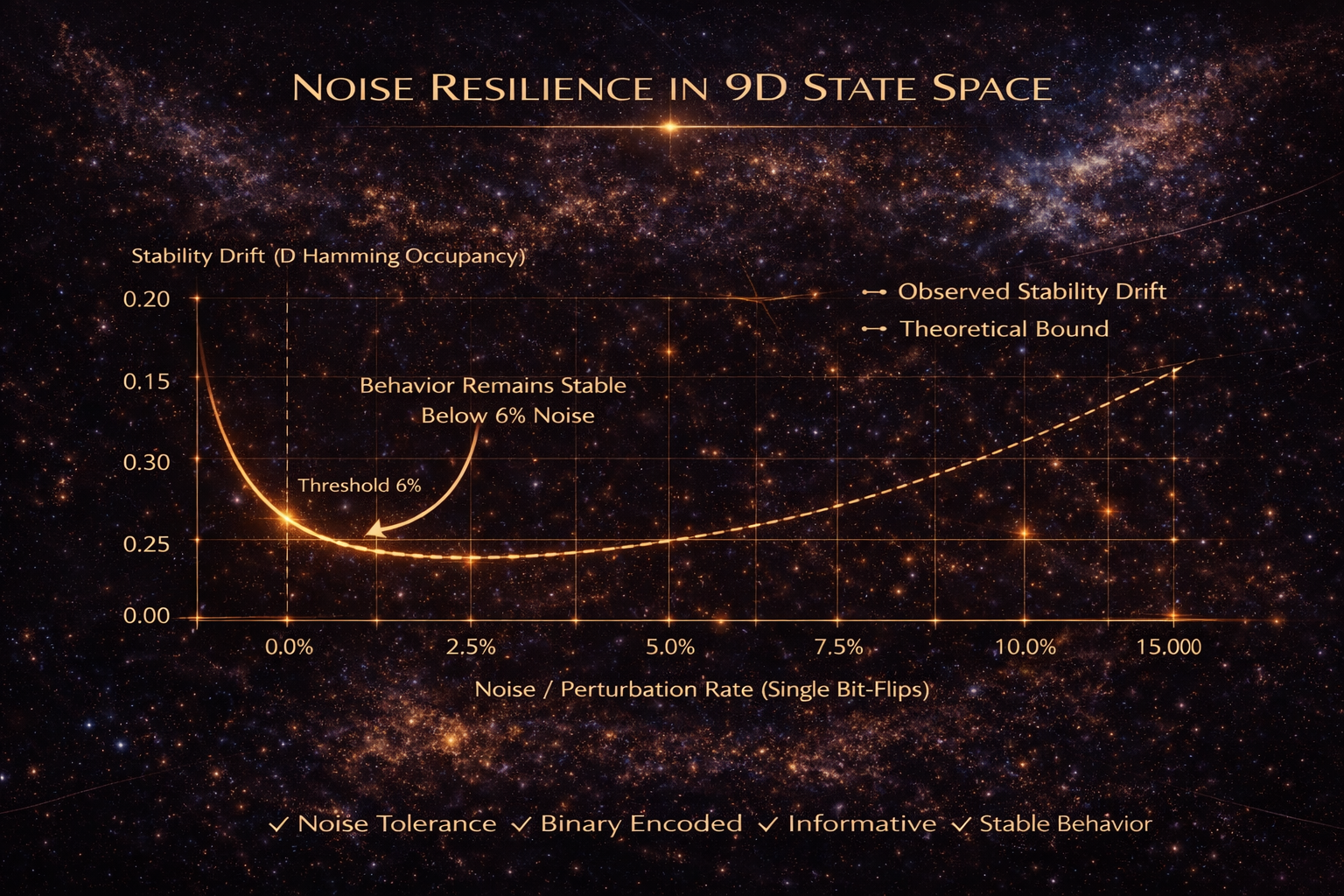
Each tick, every agent is XOR-transformed by one of the 16 codewords and then flips one uniformly random bit with the noise probability. Under controlled symmetric bit-flip noise the state occupancy converges to uniform, whose Hamming-weight marginal is exactly Binomial(9, ½) (mean 4.5, variance 2.25) — a generic finite-hypercube baseline that non-ASH controls also reproduce, not an ASH-specific result. With XOR transforms and no noise the dynamics stay confined to a 16-state code orbit (weights {0,4,8}) and do not converge (TV ≈ 0.73 from the binomial).
The controlled noise kernel is irreducible and aperiodic with a uniform stationary distribution for any rate 0 < p < 1, so there is no special “threshold” below which behaviour is stable. These are controlled, seeded, deterministic finite-Markov computations (a specified computation), not empirical or physical validation.
Controlled mixing sample — default run: 1,000 agents, 250 ticks, noise p = 0.01, seed 20260624, reaching TV = 0.032 to Binomial(9, ½). A low TV means the occupancy has mixed to the generic uniform baseline, not that ASH transforms uniquely produce it.
Error Correction Is a Decoder Property, Not a Simulation Effect
Error correction is a property of an explicit radius-1 nearest-codeword decoder, not of the simulations: when invoked it corrects every single-bit corruption (144 across all 512 states) and rejects every two-bit corruption (576 rejected, never silently healed). The Markov simulations apply noise and code XORs but never decode.
The bell-shaped Hamming-weight envelope is a generic property of the noisy 9-bit hypercube — non-ASH controls (a random weight-4 transform, or noise alone) reach the same Binomial(9, ½) baseline. The doubly-even [9,4,4] codewords supply a symbolic transformation layer inside the state space, not protection of emergent patterns from noise.
The [9,4,4] code is a classical linear error-correcting code; any comparison to quantum error correction is illustrative only — ASH does not model quantum states, decoherence, or quantum measurement.
Scientific status: This page describes interpretive and computational ASH content, not empirically established physics. ASH (v1.1.0) proves specific finite mathematics and specifies deterministic computations; it is not a validated theory of cosmology or consciousness, and the Axioms of Existence are interpretive postulates, not laws.