Convergence Dynamics
How the 512-state occupancy mixes to a uniform stationary distribution — whose Hamming-weight marginal is the Binomial(9,½) bell curve, a generic hypercube baseline that non-ASH controls also reproduce
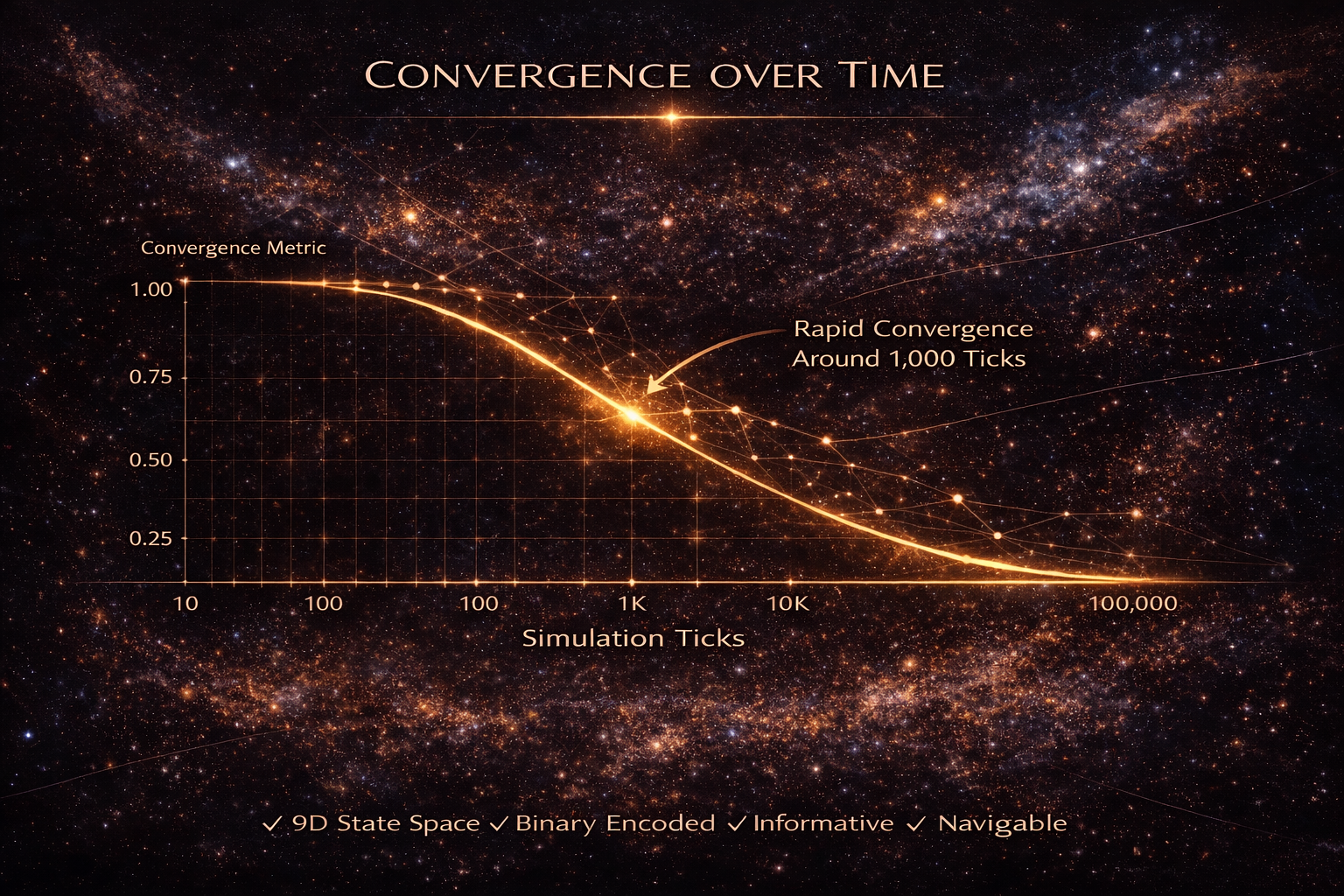
Mixing to the Uniform Baseline
Under the controlled single-bit-flip noise kernel, the state occupancy mixes toward uniform from any starting distribution, so the Hamming-weight histogram approaches the Binomial(9,½) profile (mean weight 4.5, variance 2.25, spanning the weight-4 and weight-5 shells). This bell shape is the generic uniform-hypercube baseline: a uniform start already has it, and non-ASH controls (pure noise, or a random weight-4 transform) reproduce it. ASH code (XOR) transforms with no noise instead stay confined to a 16-state code orbit (weights concentrated on 0, 4, 8) and do not converge (TV ≈ 0.73 from the binomial) — so the bell curve is not evidence of ASH-specific Gaussian convergence.
The committed reference run (1,000 agents, 250 ticks, noise p = 0.01, seed 20260624, uniform start, ASH transform) reaches a total-variation distance of 0.032 to the Binomial(9,½) baseline. There is no separate “6% noise threshold”: the noise kernel mixes to uniform for any 0 < p < 1.
Markov Chain Analysis
The dynamics form a finite-state Markov chain on F29 (512 vertices of the 9-cube Q9, degree 9). Irreducibility and aperiodicity come from the noise kernel, not the XOR transforms: the lazy single-bit-flip kernel P = (1−p) I + (p/9) Σi Fi is symmetric, doubly stochastic, irreducible and aperiodic (self-loop probability 1−p), so by the Perron–Frobenius theorem it has a unique stationary distribution — the uniform law on all 512 states.
ASH XOR code translations alone are not irreducible: with no noise they stay inside a single 16-state code orbit (the canonical [9,4,4] code has 16 codewords, weight enumerator {0:1, 4:14, 8:1}), so the mixing is driven by the noise, not by the ASH transform.
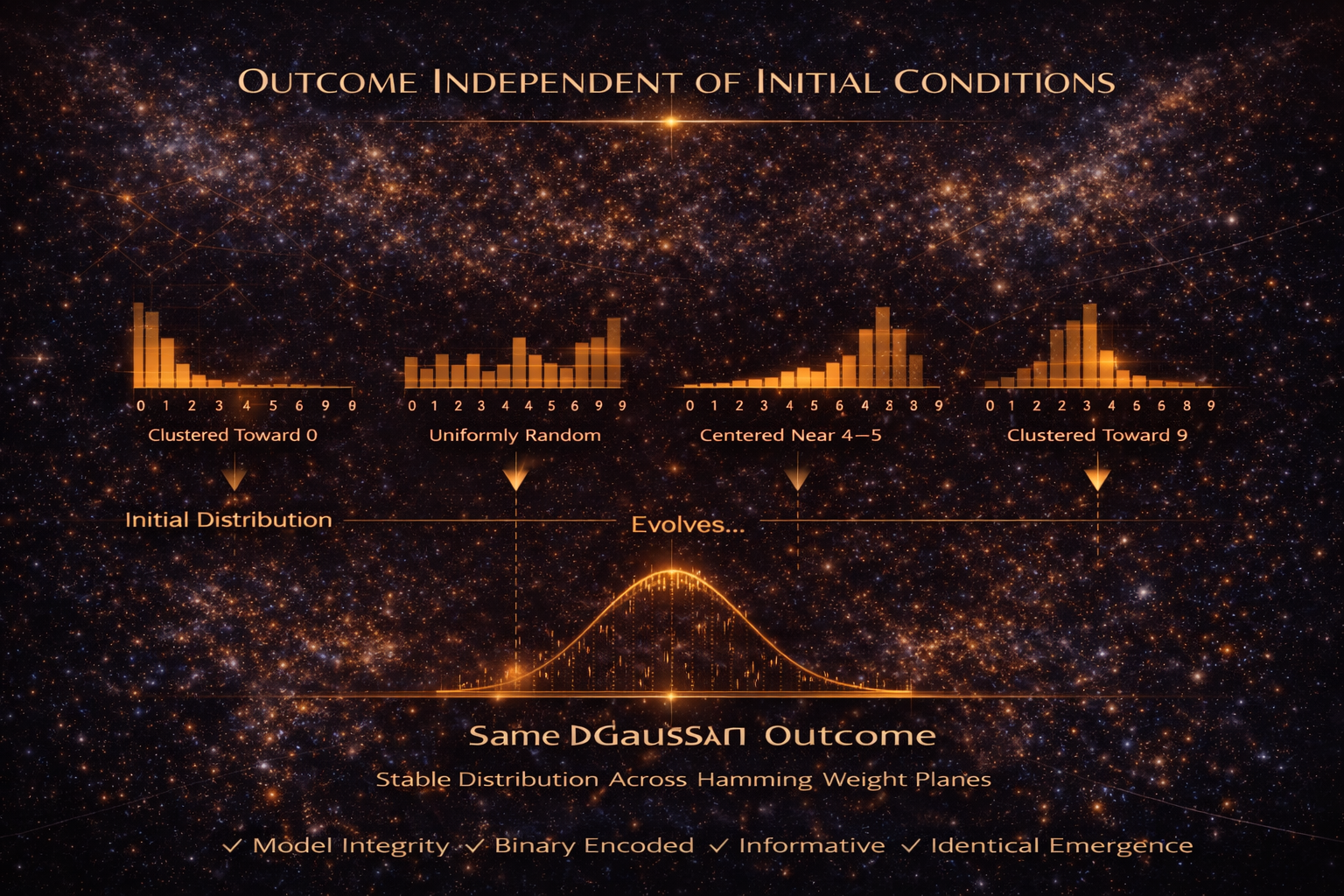
Initial Condition Independence
With noise present, four starting configurations — clustered at weight 0, uniformly random, centred near the weight-4/5 shells, and clustered at weight 9 — all relax to the same uniform stationary law, whose Hamming-weight marginal is Binomial(9,½). This initial-condition independence is a generic consequence of the symmetric noise kernel and is reproduced by non-ASH controls; it is not an ASH-specific result. (Without noise, the corner starts would remain confined to a code orbit and would not mix.)
What this shows
These are controlled, seeded finite-Markov computations — a specified deterministic computation, not empirical results. The mixing to Binomial(9,½) is a generic uniform-hypercube baseline that non-ASH controls reproduce; it is not evidence of ASH-specific dynamics, quantum measurement, or physical cosmology.
Scientific status: This page describes interpretive and computational ASH content, not empirically established physics. ASH (v1.1.0) proves specific finite mathematics and specifies deterministic computations; it is not a validated theory of cosmology or consciousness, and the Axioms of Existence are interpretive postulates, not laws.