Mathematical Foundations
Formal proofs and theoretical underpinnings
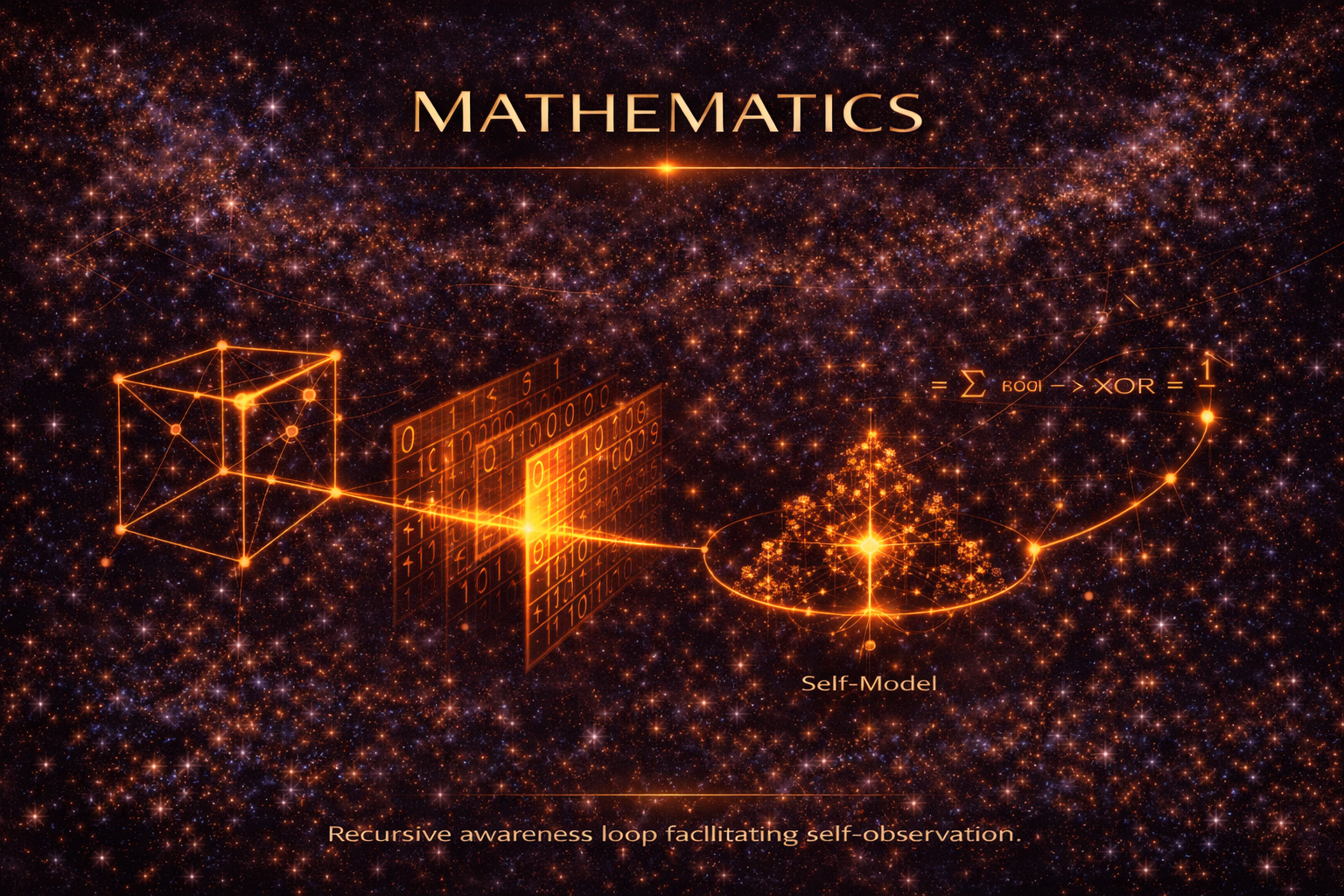
The results below are proved finite mathematics about the model’s 9-bit state space (F29 = 512 vertices of the hypercube Q9) and its doubly-even [9,4,4] transform code. They establish the finite algebra and its deterministic semantics only. They do not, by themselves, establish ASH as an empirical theory of physics or cosmology, do not derive quantum measurement, and do not show that ASH transforms uniquely generate Gaussian statistics — those remain interpretive research questions requiring separate observational evidence.
Three Core Proofs
1. Idempotence of the Code-Orbit Averaging Operator
T² = T. Since C is the linear [9,4,4] code (|C| = 16), for fixed c, as d ranges over C, {c ⊕ d} = C. Therefore T²f(x) = (1/|C|²) ∑c,d f(x ⊕ c ⊕ d) = (1/|C|) ∑e f(x ⊕ e) = Tf(x). The operator (Tf)(x) = (1/16) ∑c∈C f(x ⊕ c) is therefore a self-adjoint idempotent projection onto functions constant on code orbits (verified idempotence residual exactly 0). □
2. Error-Correction Bound
A code with minimum distance d corrects weight-t errors when 2t < d. For received r = c ⊕ e, any other codeword c′ satisfies d(r,c′) ≥ d – t > t = d(r,c), making c the unique nearest codeword. □
For the canonical [9,4,4] transform code the minimum distance is d = 4, so guaranteed correction reaches only radius t = 1: every one of the 144 single-bit corruptions of the 16 codewords decodes uniquely, while all 576 two-bit corruptions are rejected by policy rather than silently healed (exhaustive decoding of all 512 states yields 16 exact, 144 corrected, 352 uncorrectable). This recovery is a property of an explicit radius-1 nearest-codeword decoder call, not an effect produced by the stochastic ASH simulations, which apply noise and code XORs but never decode.
3. Stationary Distribution
The chain is irreducible (noise enables single-bit flips, reaching any vertex in ≤9 steps) and aperiodic (self-loops have positive probability). By Perron-Frobenius, a unique π exists with πP = π. □
For 0 < p < 1 this unique π is the uniform distribution over all 512 states, whose Hamming-weight marginal is exactly Binomial(9,1/2) (mean 4.5, variance 2.25). The resulting bell-shaped histogram is a generic finite-hypercube baseline — reproduced by non-ASH controls and by a uniform start with no transform — and is not an emergent or ASH-specific result. With XOR transforms and no noise the dynamics instead stay confined to a 16-state code orbit (Hamming weights {0, 4, 8}) and do not converge (total-variation distance ≈ 0.73 from the binomial).
References
Background and context (not results derived by ASH). The Adinkra references are directly used by the finite construction; the string-theory, holography, and lattice-optimality works are cited for context only.
- Faux & Gates (2005)Adinkra graphs for SUSY representation theory
- Doran et al. (2007)Graph-theoretic identifications of adinkras
- Almheiri et al. (2015)Quantum error correction in AdS/CFT
- Green & Schwarz (1984)Anomaly cancellation in D=10 superstring theory
- Polchinski (1998)String Theory
- Cohn et al. (2019)E8 and Leech lattice universal optimality
Scientific status
ASH is an exploratory finite-mathematics and computational-ontology framework (reference implementation v1.1.0). Its claims fall into three tiers: proved finite mathematics, specified deterministic computation, and interpretive research hypotheses. It is not an empirically validated theory of physics, cosmology, or consciousness — it does not derive a Friedmann equation, spacetime metric, dark energy, or the CMB, does not establish that its branching realizes quantum measurement, and has no confirmed observational predictions. The five Axioms of Existence are interpretive postulates, not established laws.