Procedural Branching
Structured output from simple deterministic rules applied iteratively
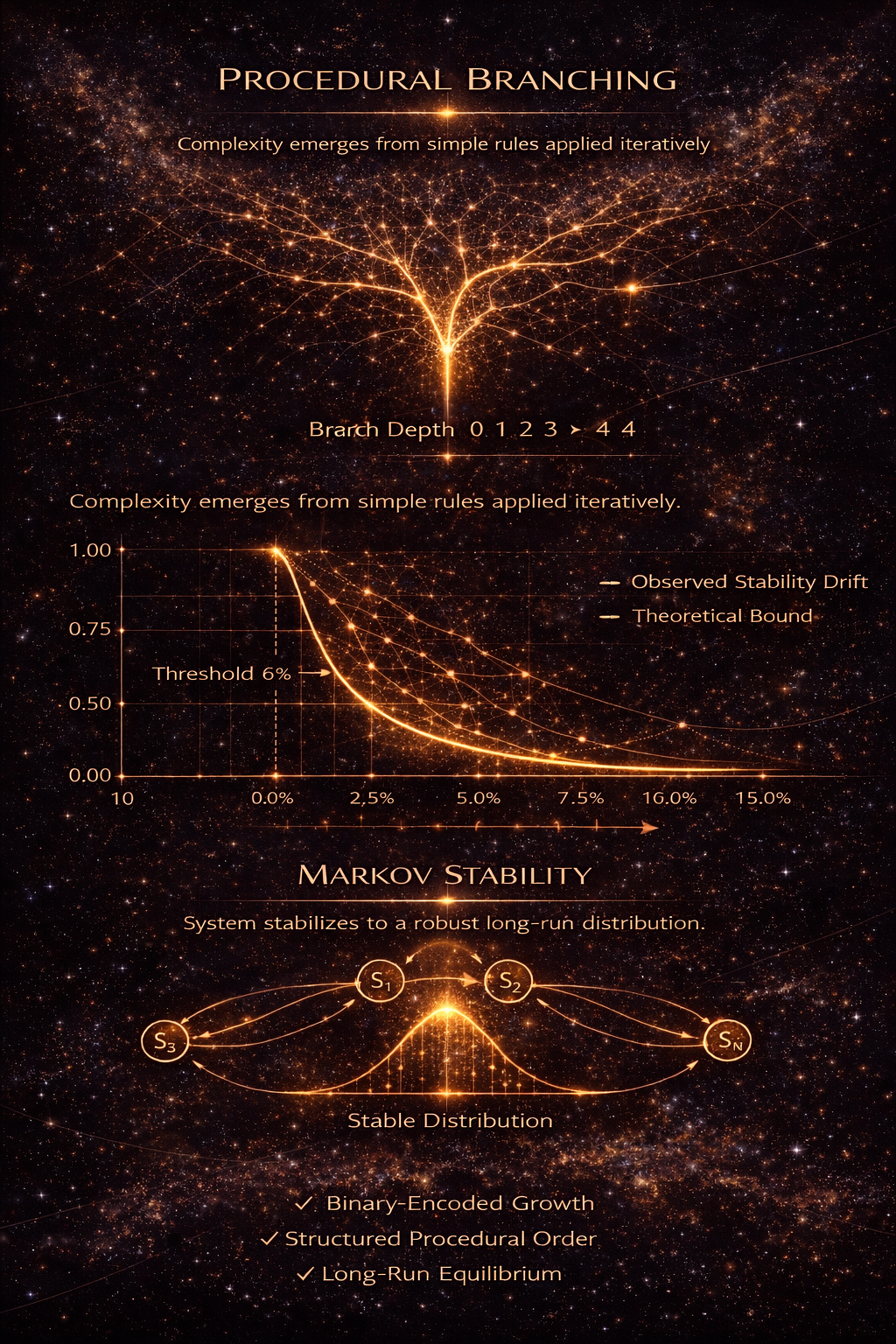
L-System Branching
The branch layer is a specified deterministic depth-4 ternary tree (121 nodes, 81 leaves, 16 codeword messages), rendered with an L-system — a versioned engineering construction, not a quantum-measurement, decoherence, or Many-Worlds process. The repository does not establish that its branching realizes quantum measurement.
Each node has three children corresponding to the actions 0, + and −, with fixed priors P(0) = 0.50, P(+) = P(−) = 0.25 that sum to exactly 1.0. Building to a fixed depth of 4 yields 34 = 81 leaves across 121 nodes, and the level-toggle rule reaches all 16 code-orbit messages. The verified properties are finite and bounded: leaf weights are normalized and conserved (sum = 1.0), every codeword is reached, and every leaf state stays integrity-valid (coordinate 8 preserved). The visible tree shape comes from a separate L-system rendering rule (F → FF[+F]F[-F], 25° turn, 0.72 length decay) — display geometry, not dynamics.
Markov Mixing Under Controlled Noise
Under controlled symmetric bit-flip noise the state occupancy converges to uniform, whose Hamming-weight marginal is exactly Binomial(9, ½) (mean 4.5, variance 2.25) — a generic finite-hypercube baseline that non-ASH controls also reproduce, not an ASH-specific result. With XOR transforms and no noise the dynamics stay confined to a 16-state code orbit (weights {0,4,8}) and do not converge (TV ≈ 0.73 from the binomial).
The committed default run (1,000 agents × 250 ticks, seed 20260624, noise p = 0.01) reaches total-variation distance TV = 0.032 to Binomial(9, ½). The Markov simulation is a separate process from the branch tree: each tick it XORs every agent by a random codeword and then optionally flips a single bit with probability p. It never itself branches, and it never decodes — convergence therefore requires generic mixing, not the ASH transform.
Three Distinct Constructs
None of these is a physically emergent process. The Markov simulation applies XOR-by-codeword plus an optional single-bit noise flip, and does not branch. The candidate tree applies the 0 / + / − actions to a fixed depth of 4. The visible fractal-looking shape is produced by the separate L-system rendering rule (F → FF[+F]F[-F], 25° turn, 0.72 length decay) — display geometry only. Each is a specified deterministic computation: repeating simple rules produces structured output, but nothing here is derived physics.
Scope
The branch structure is a specified deterministic computation. Its depth, ternary action set, priors (0.50 / 0.25 / 0.25) and rendering geometry are versioned reference-design choices, not uniquely derived constants. The verified properties are that leaf weights are normalized and conserved (sum = 1.0), all 16 code-orbit messages are reached, and every leaf state stays integrity-valid. Physical or quantum interpretations of branching are interpretive research hypotheses, not established results.
Scientific status: This page describes interpretive and computational ASH content, not empirically established physics. ASH (v1.1.0) proves specific finite mathematics and specifies deterministic computations; it is not a validated theory of cosmology or consciousness, and the Axioms of Existence are interpretive postulates, not laws.