Computational Simulation
A controlled finite-Markov model on the 9-bit hypercube (Q9) — specified deterministic computation, not a derivation of physical cosmology.
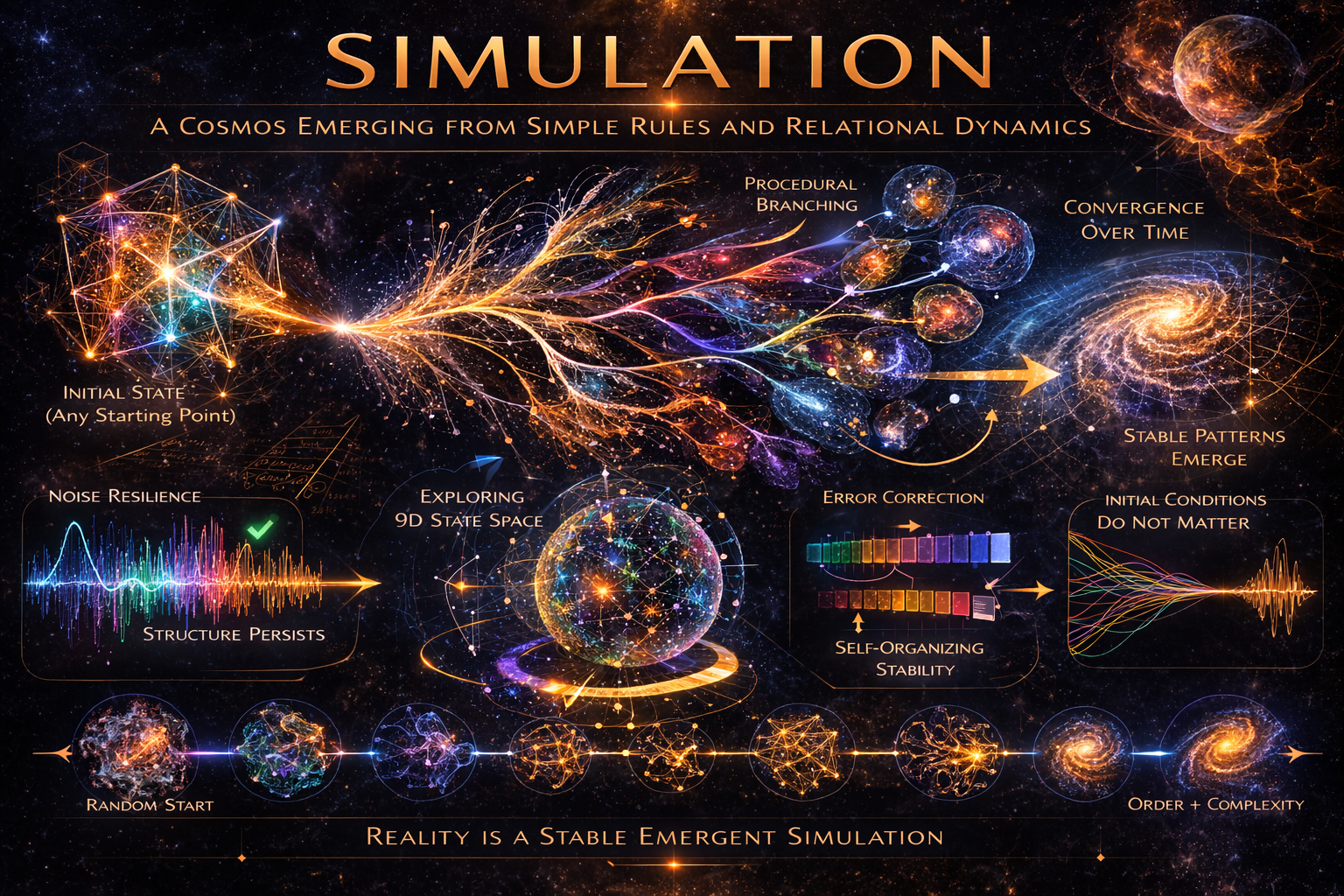
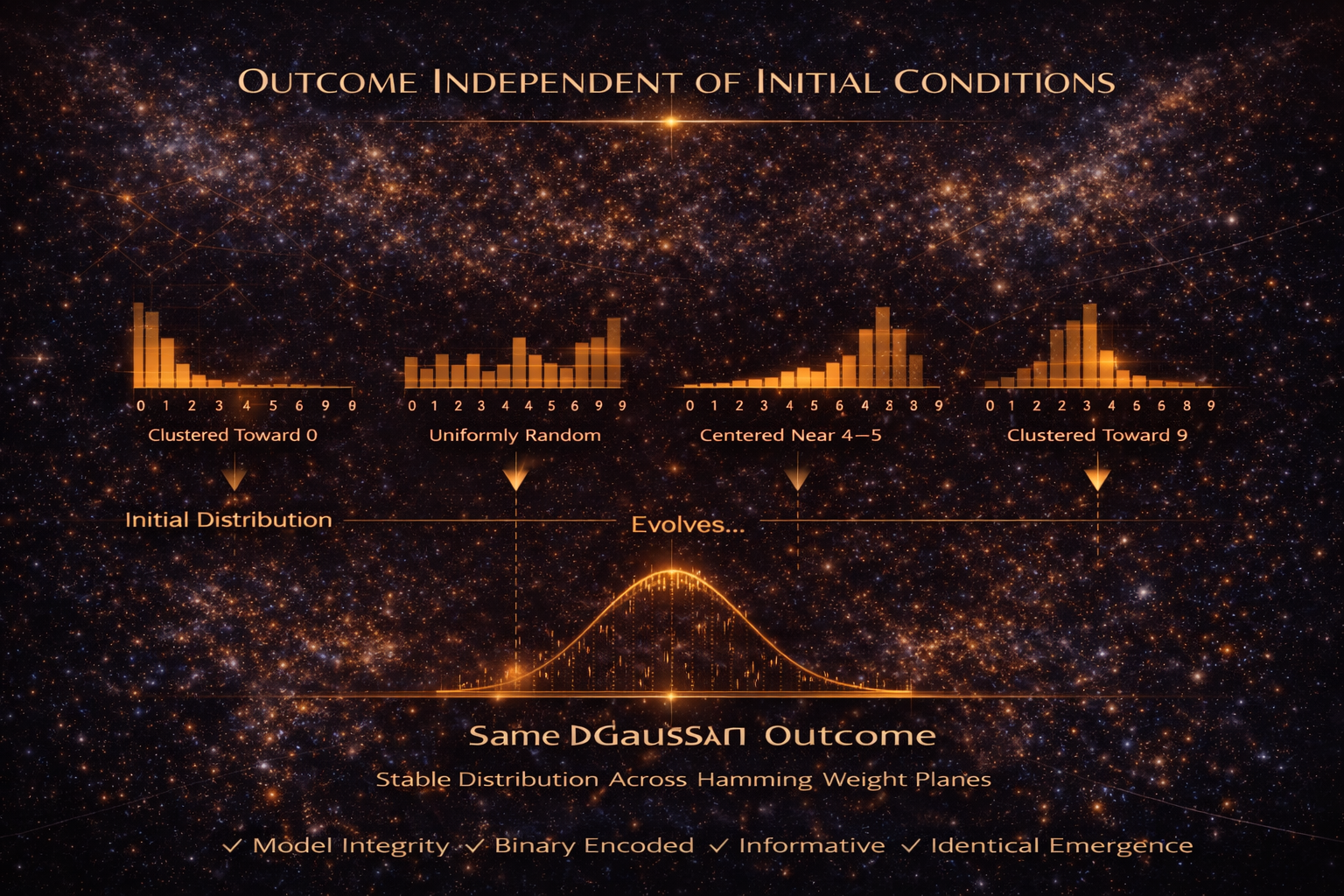
Each tick, every agent is XOR’d with an independently chosen codeword from the 16-word [9,4,4] transform code, then flips one uniformly random bit with probability p = 0.01. These are controlled, seeded finite-Markov runs (committed run: 1,000 agents × 250 ticks, seed 20260624); their stable Hamming-weight envelope is the generic Binomial(9, ½) baseline of uniform 9-bit occupancy, not an ASH-specific emergent result.
These simulations are controlled, seeded, deterministic finite-Markov computations. Their outputs are specified computation, not empirical or physical validation. The bell-shaped Hamming-weight histogram is the generic Binomial(9, ½) marginal of uniform 9-bit occupancy (mean 4.5, variance 2.25) — reproduced by non-ASH controls — and error correction is a separate proven decoder property, not something these runs perform.
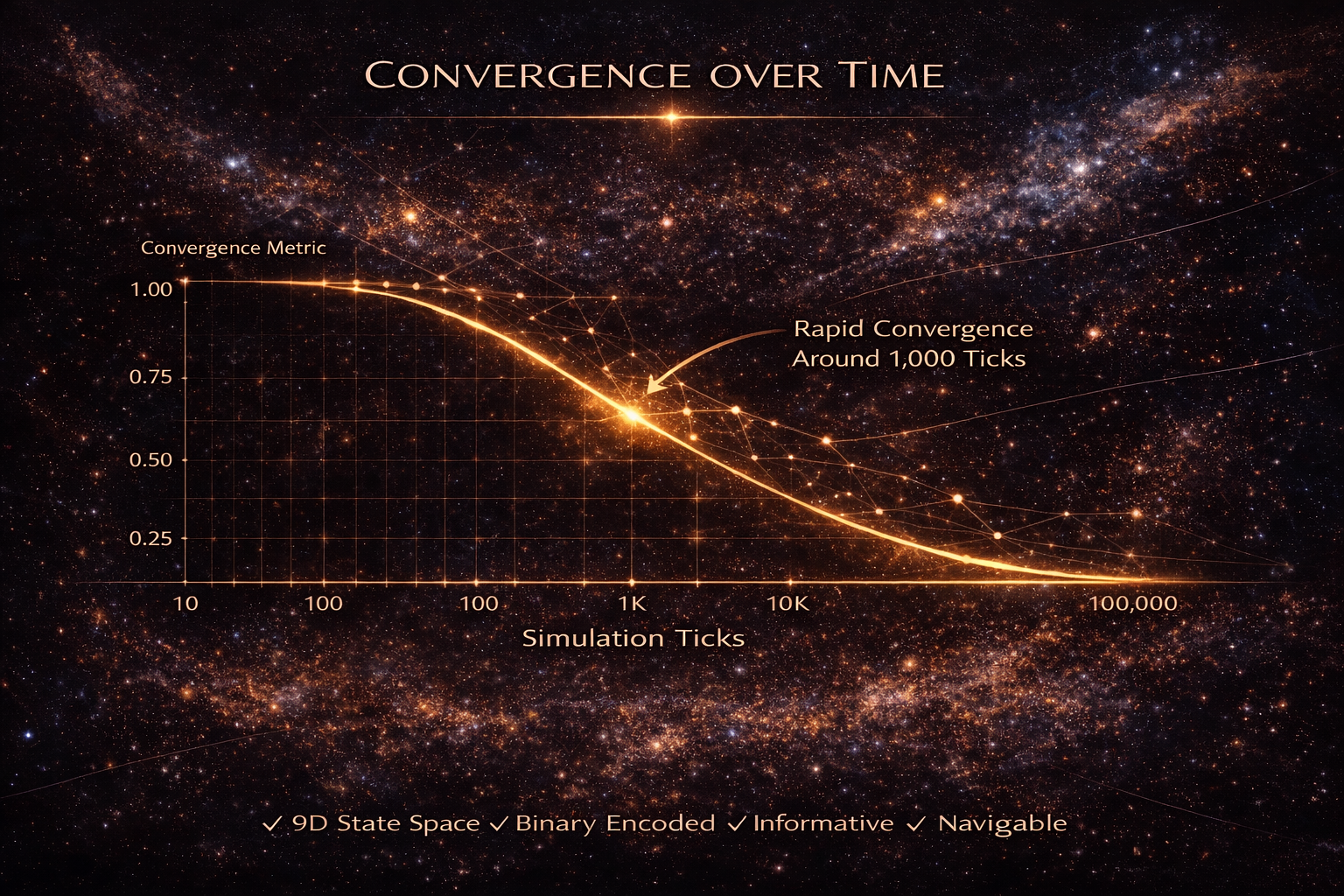
Convergence Dynamics
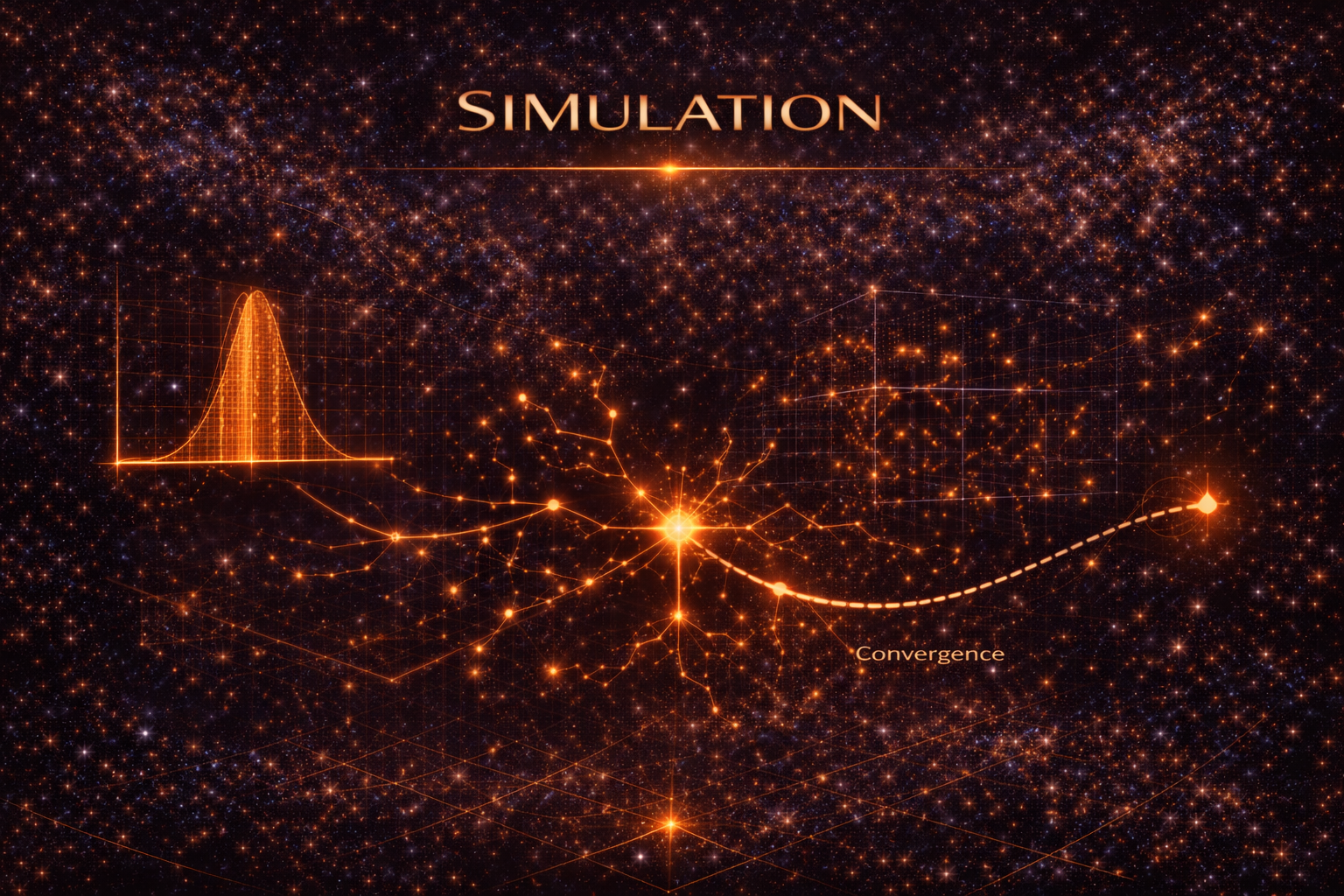
Under controlled symmetric bit-flip noise the state occupancy converges to uniform, whose Hamming-weight marginal is exactly Binomial(9, ½) (mean 4.5, variance 2.25) — a generic finite-hypercube baseline that non-ASH controls also reproduce, not an ASH-specific result. With XOR transforms and no noise the dynamics stay confined to a 16-state code orbit (weights {0,4,8}) and do not converge (TV ≈ 0.73 from the binomial). The committed run reaches TV = 0.032 from the binomial by 250 ticks.
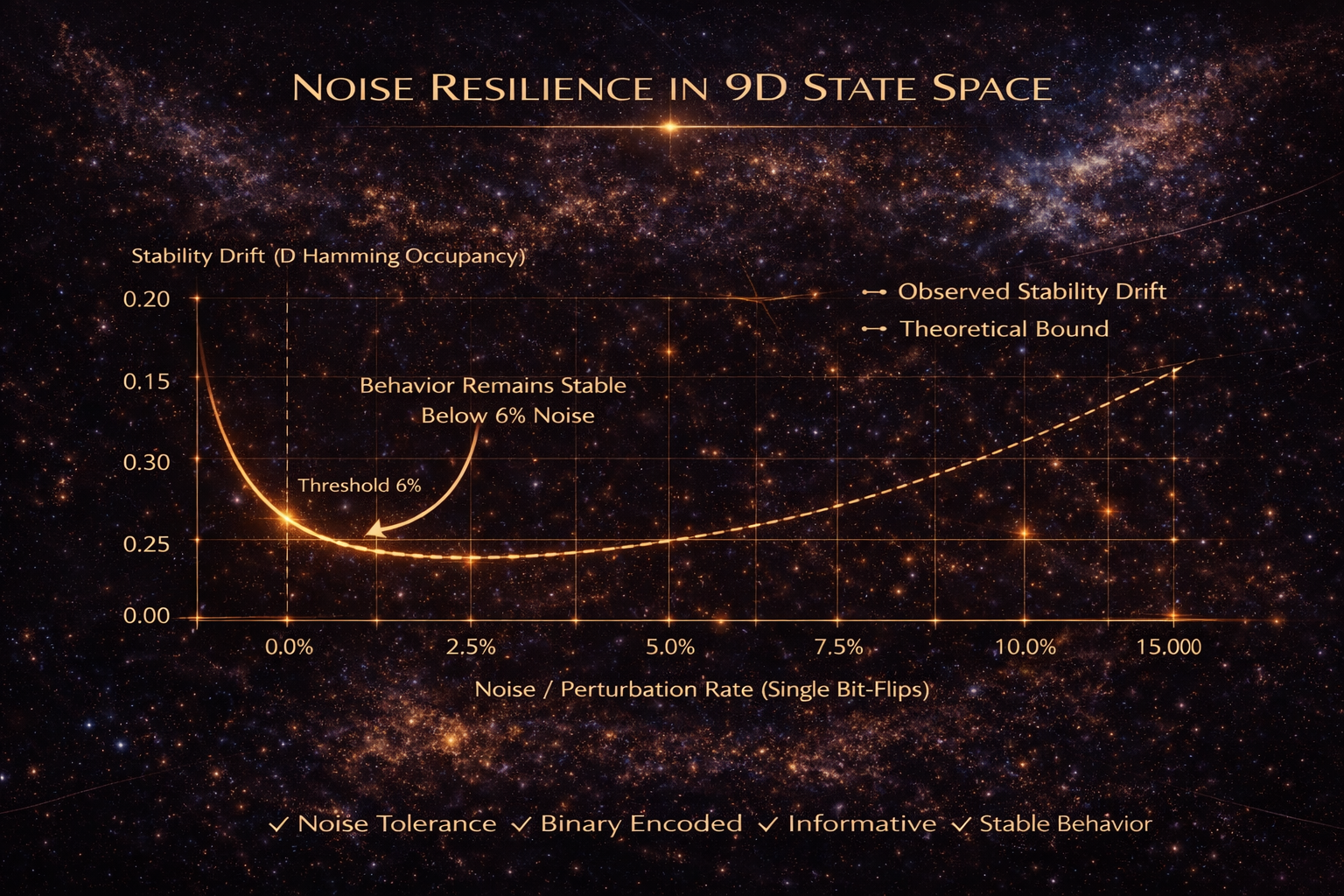
Controlled-Noise Mixing
Symmetric single-bit-flip noise is doubly-stochastic and drives the occupancy toward the uniform stationary distribution for any noise rate 0 < p < 1 — there is no special stability threshold. The runs apply noise and code XORs but never decode. Error correction is a property of an explicit radius-1 nearest-codeword decoder, not of the simulations: when invoked it corrects every single-bit corruption (144 across all 512 states) and rejects every two-bit corruption (576 rejected, never silently healed).
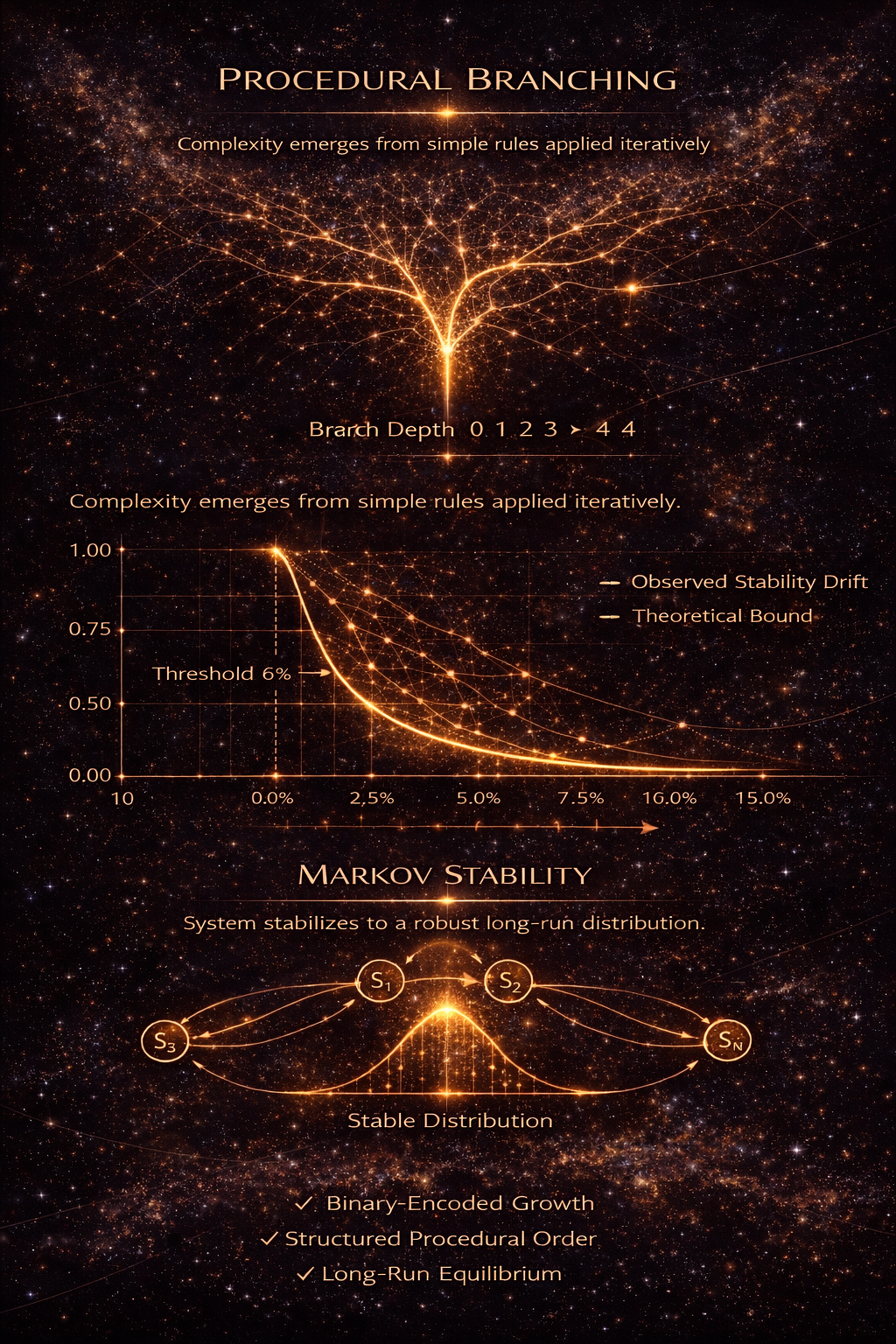
Procedural Branching
The branch layer is a specified deterministic depth-4 ternary tree (121 nodes, 81 leaves, 16 codeword messages), rendered with an L-system — a versioned engineering construction, not a quantum-measurement, decoherence, or Many-Worlds process. The repository does not establish that its branching realizes quantum measurement.
Initial Conditions & Noise
When single-bit-flip noise is present, different starting configurations mix to the same uniform stationary occupancy, whose Hamming-weight marginal is Binomial(9, ½). This depends on the noise: with ASH transforms but no noise, an all-zero start stays confined to a 16-state code orbit (weights {0,4,8}) and does not spread (TV ≈ 0.73 from the binomial baseline).
Scientific status
ASH is an exploratory finite-mathematics and computational-ontology framework (reference implementation v1.1.0). Its claims fall into three tiers: proved finite mathematics, specified deterministic computation, and interpretive research hypotheses. It is not an empirically validated theory of physics, cosmology, or consciousness — it does not derive a Friedmann equation, spacetime metric, dark energy, or the CMB, does not establish that its branching realizes quantum measurement, and has no confirmed observational predictions. The five Axioms of Existence are interpretive postulates, not established laws.