Academic Research
Finite-mathematics proofs, specified deterministic computation, and interpretive research on the ASH Model (reference implementation v1.1.0)
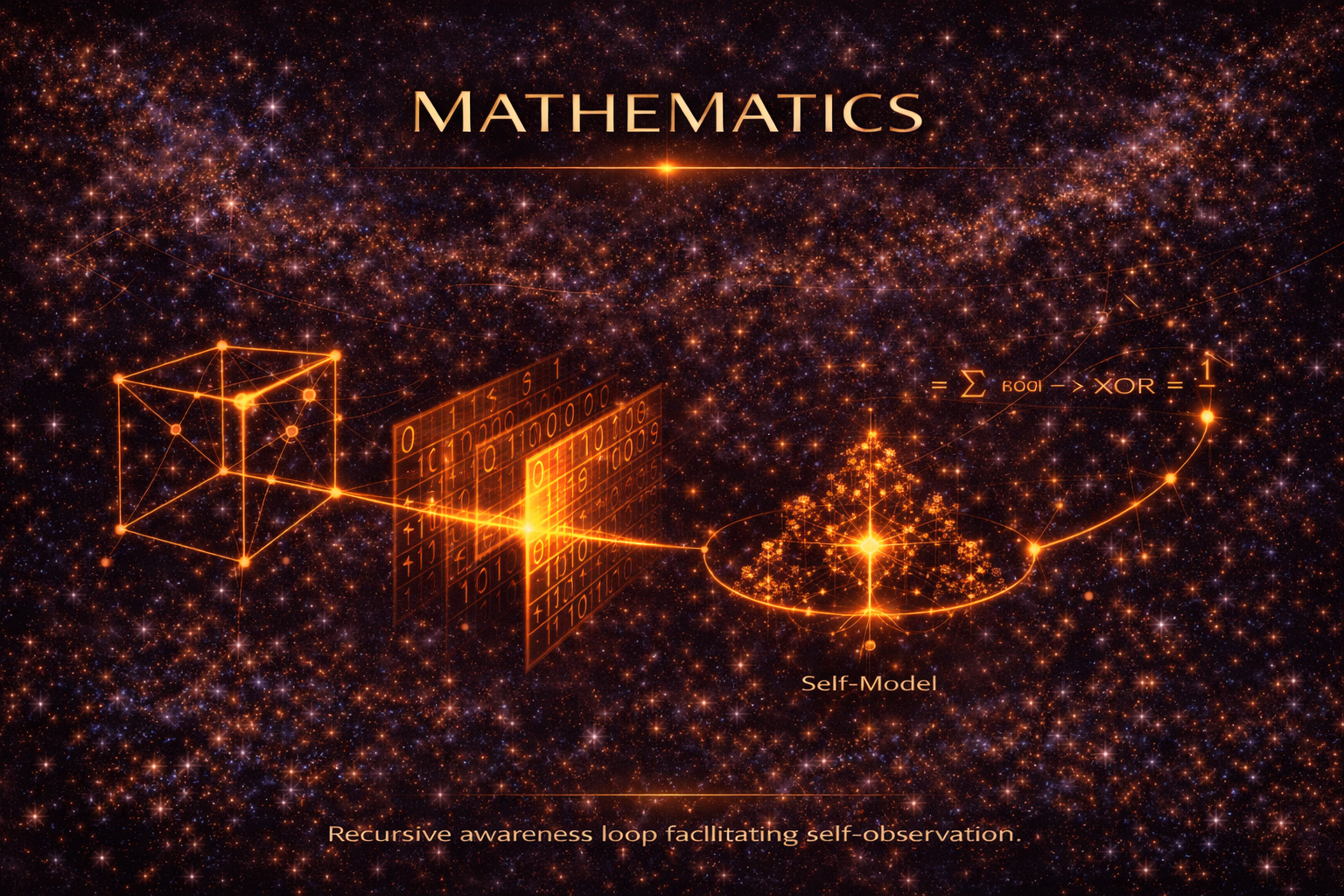
Mathematical Foundations
Three core proofs: averaging-operator idempotence (T²=T), the radius-1 nearest-codeword decoder bound for the [9,4,4] code, and existence of the unique stationary distribution under the controlled-noise kernel.
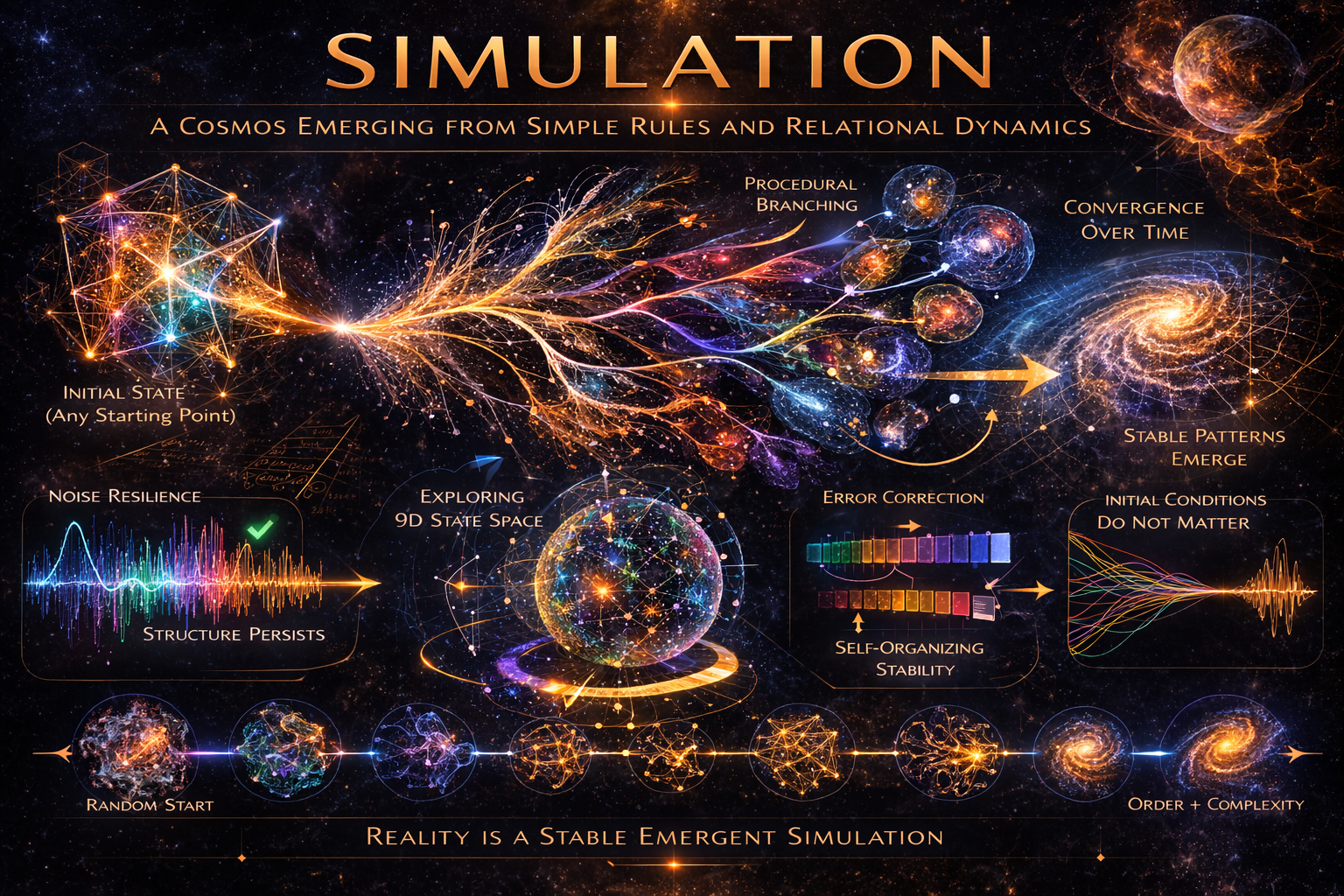
Simulation Results
Controlled-noise mixing to the generic Binomial(9,½) Hamming-weight baseline, ablation and code-orbit controls, deterministic branch-tree geometry (depth-4 ternary tree; L-system rendering), and seeded, reproducible simulation data.
Paper Status
“Adinkra-Stabilized Hypercube Model: Canonical Algebra, Mapping Semantics, and Controlled Simulations” by James Daley (v1.1.0, June 2026). An exploratory finite-mathematics and computational-ontology framework: it proves the finite algebra and validates deterministic mapping semantics; the procedural-cosmology reading is an interpretive hypothesis, not an empirically validated cosmology. The earlier Figshare preprint (“Procedural Cosmology in 9 Dimensions”) is superseded by this v1.1.0 audit-remediation release.
References
- Faux & Gates (2005)Adinkra graphs for SUSY representation theory
- Doran et al. (2007)Graph-theoretic adinkra identifications
- Almheiri et al. (2015)Quantum error correction in AdS/CFT
- Green & Schwarz (1984)Anomaly cancellation in D=10
- Polchinski (1998)String Theory
- Cohn et al. (2019)E8 and Leech lattice optimality
Future Directions
Quantum Amplitudes
Exploring whether the classical, discrete finite-state framework could be extended toward quantum probability amplitudes — an open research direction, not a current capability.
Richer SUSY Multiplets
Expanding the finite Adinkra/Garden-algebra construction (the N=8 layer built from the punctured [8,4,4] code) toward extended supersymmetry representations.
Tensor Networks
Representing the finite hypercube dynamics in a tensor-network formalism.
Dimensional Studies
Comparative analysis in 8D/10D to explore how the finite construction behaves in adjacent dimensions — noting that self-duality holds only for the punctured [8,4,4] code, not in nine dimensions, so nine bits is a versioned modeling choice (8 measurement coordinates + 1 recomputed XOR-parity bit), not a privileged status.
Scientific status
ASH is an exploratory finite-mathematics and computational-ontology framework (reference implementation v1.1.0). Its claims fall into three tiers: proved finite mathematics, specified deterministic computation, and interpretive research hypotheses. It is not an empirically validated theory of physics, cosmology, or consciousness — it does not derive a Friedmann equation, spacetime metric, dark energy, or the CMB, does not establish that its branching realizes quantum measurement, and has no confirmed observational predictions. The five Axioms of Existence are interpretive postulates, not established laws.